Showing posts with label Edible. Show all posts

Friday, June 26, 2020

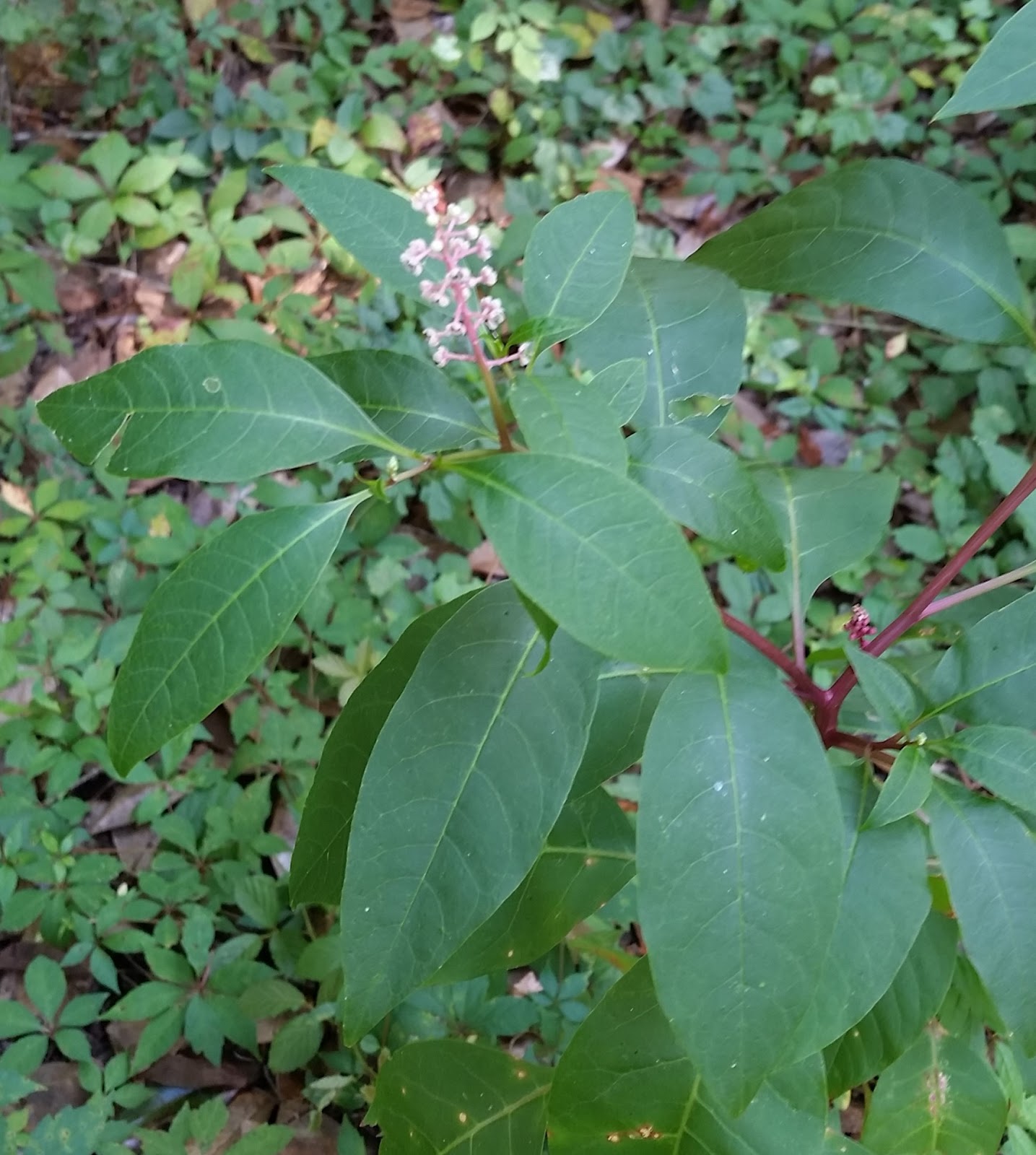
Pokeweed

Common Names: Pokeweed, American pokeweed, poke salad, poke sallet, pokeberry, inkberry, American nightshade, American spinach, scoke, pigeonberry, dragonberries, red weed, red ink
Latin Names: Phytolacca americana
Type: Herbaceous
Origin: Native

Edible: Poisonous when any part is eaten raw. Young shoots and leaves can be boiled and eaten. Some sources say it must be boiled 2-3 times with the water changed each time.

Other uses: Medicinal uses. Dye and ink from the berries. Birds eat the berries.

Note: In the back near the woods.

Pokeweed (June)

Pokeweed (June)

Friday, June 12, 2020

American Beautyberry

Common Names: American beautyberry, French mulberry, sourbush, bunchberry, purple beauty-berry
Latin Names: Callicarpa americana
Type: Herbaceous
Origin: Native

Edible: A few berries can be eaten raw but they are very astringent. They can safely be eaten in jams, jellies, and wine. The root can make a tea.

Other uses: Various medicinal uses. Fresh crushed leaves are said to keep mosquitoes away. The whole plant if planted next to a house is said to help keep mosquitoes from the area. Birds and animals like the berries.

Note: Edge of the woods in front and back.

American beautyberry (April)

American beautyberry (April)

American beautyberry (April)

American beautyberry (June)

American beautyberry (June)

American beautyberry (June)


Sunday, June 7, 2020

Wild Lettuce

Common Names: Wild lettuce, bitter lettuce, opium lettuce, poisonous lettuce, tall lettuce, great lettuce
Latin Names: Lactuca virosa
Type: Herbaceous
Origin: Introduced from Europe but not considered invasive.

Edible: The leaves are bitter but edible. Younger leaves are better. Can be eaten raw or cooked as a potherb or boiled.

Other uses: Medicinal - The plant secrets a white milky substance from the veins. When it is dried it is used for sedative and pain-relief effects. Referred to as poor man's opium.

Wild lettuce (April)


Monday, June 1, 2020

Rowan

Common Names: Rowan, American Mountain Ash (for americana), European Mountain Ash (for acuparia)
Latin Names: Sorbus americana or Sorbus aucuparia or some other variety
Type: Tree
Origin: Native?

Edible: Fruit is not good raw but good cooked such as in jam, jelly, and syrup.

Other uses: Medicinal uses. Wood can be used for wood carving. Bark can make a red brown dye.

Note: Unsure of species on this one. Too far south for americana and aucuparia  but haven't found a species in Florida. Haven't seen the fruit yet. These trees are still small and along our tree line.

Rowan (June)


Rowan (June)

Rowan (June)

Thursday, May 21, 2020

Lyre-leaf Sage

Common Names: Lyre-leaf sage, wild sage, cancerweed, cancer root
Latin Names: Salvia lyrata
Type: Herbaceous
Origin: Native

Edible: Leaves can be used in a salad or as a potherb. The young leaves are the most tender. Flowers are edible in a salad. Seeds can be ground and mixed with other grains to make flour. Entire plant can be dried to make a tea and often used to sooth a sore throat.

Other uses: Medicinal. Attracts butterflies and hummingbirds.

Note: Leaves or roots were thought to be an external cure for skin cancer in the past. Others say it it is called cancerweed because it "spreads like cancer". Mostly found in the lawn or around the pond.
Lyre-leaf sage (April)


Lyre-leaf sage (April)

Sunday, May 3, 2020

Cutleaf Evening Primrose

Common Names: Cutleaf evening primrose
Latin Names: Oenothera lacinata
Type: Herbaceous
Origin: Native

Edible: Young leaves and flowers are edible raw in a salad or cooked as a potherb. Root can be cooked but may take a few changes of water.
--> Leaves and flowers are pretty good raw in early May.

Other uses: Attracts bees. Some medicinal uses.

Cutleaf evening primrose (April)

Cutleaf evening primrose (April)

Cutleaf evening primrose (April)

Cutleaf evening primrose (April)

Low Hop Clover

Common Names: Low hop clover, lesser trefoil, suckling clover, little hop clover, lesser hop trefoil
Latin Names: Trifolium dubium
Type: Herbaceous
Origin: Europe

Edible: Leaves and flowers are edible either raw in a salad or cooked as a potherb.

Other uses: Fixes nitrogen so farmers may use this in a rest period on a field.

Low hop clover (April)

Low hop clover (April)

Low hop clover (April)

Low hop clover (April)


Late Goldenrod

Common Names: Late goldenrod, tall goldenrod, Canada goldenrod
Latin Names: Solidago altissima
Type: Herbaceous
Origin: Native

Description:  The plant is 3-6’ tall. The stem has fine hairs. The small flowers are yellow and arranged along the upper branches.

Edible: Leaves and flowers are edible either raw in a salad or cooked as a potherb or to make a tea.
Other uses: Medicinal uses. Attracts birds and butterflies.
Notes: There are many varieties of goldenrod. This is my best guess.


Goldenrod (June)

Goldenrod (December)

Goldenrod (April)

Goldenrod (September)


Goldenrod (December)

Goldenrod (September)

Goldenrod (September)

Tuesday, April 28, 2020

Beggar's Tick

Common Names: Beggar's tick, beggarticks, Spanish needles, monkey’s lice, shepherd's needles, butterfly needles
Latin Names: Bidens alba
Type: Herbaceous
Origin: Native

Description: The plant grows up to 5 foot tall. Stems are mostly hairless and green to purplish. Leaves are either simple or compound and can be 1-4” long. The small flowers are normally white but can be yellow or cream. A plant can produce hundreds of seeds which have two-tooths or barbs at the top to grab on to animals fur and spread.

Edible: Young leaves and flowers are edible either raw in a salad or cooked as a potherb. Dried leaves can be used to make a tea.

--> Raw leaves and flowers are good but so small that it would take several plants to make a salad.

Other uses: Attracts bees and butterflies. Has some medicinal uses such as leaf infusion or tea for sore throats. Powdered seeds are a topical anesthetic and to help clotting.
Notes: Found along the woods.


Beggar's tick (September)


Beggar's tick (September)

Beggar's tick (September)

Beggar's tick (September)


Beggar's tick (April)

Beggar's tick (June)


Saturday, April 18, 2020

Saw Palmetto

Common Names: Saw palmetto
Latin Names: Serenoa repens
Type: Herbaceous
Origin: Native

Edible: Fruit is edible.

Other uses: Fruit is a food source for animals. Bees are attracted to the flowers in the spring.

Note: "Saw" on edges of stems.

Saw palmetto (April)

Sunday, April 12, 2020

Spiderwort

Common Names: Spiderwort, common spiderwort, Ohio spiderwort, blue jacket
Latin Names: Tradescantia ohiensis
Type: Herbaceous
Origin: Native

Edible: Stalks can be cooked like asparagus, flowers and leaves can be eaten in a salad.
--> Flowers are OK tasting. Can't see that it would be much more than decoration on a salad unless I found a bigger source.

Note: Found along road.

Spiderwort (April)

Spiderwort (April)

Spiderwort (April)


Wednesday, April 8, 2020

Black Huckleberry

Common Names: Black huckleberry, common huckleberry, high-bush
Latin Name: Gaylussacia baccata
Type: Shrub
Origin: Native

Edible: Berries (black or dark blue) are eaten raw or in jams, jellies, pies, muffins, and pancakes. Native Americans used to dry the berries to use them in the winter or to travel.

Other uses: Many different animals eat the berries and may eat them quickly so that it is hard for us to find the ripe berries. The flowers attract butterflies.

Note: These are along the tree lines in back. They are ~5 feet in height. I read that they have yellow spots under the leaf that sparkle in the sun. I need to look for this yet.

Black huckleberry (April)

Black huckleberry (July)

Black huckleberry (July)


Black huckleberry - green unripe berries (May)
Black huckleberry - ripe & unripe berries (June)

Tuesday, April 7, 2020

Wood Sorrel

Common Names: Wood sorrel, oxalis, yellow sorrel, false shamrocks, sourgrass, lemon clover
Latin Names: Oxalis stricta
Type: Herbaceous
Origin: Native

Edible: Leaves and flowers are edible but acidic so eat only in small quantities. Normally eaten raw or as garish in a salad. Leaves can be used to make a tea. The juice can be used as a substitute for vinegar. Contains vitamin C.

Uses: Can be boiled for an orange dye. some medicinal uses.

Wood sorrel (April)

Wood sorrel (April)

White Clover

Common Names: Clover, trefoil, white clover
Latin Names: Trifolium repens
Type: Herbaceous
Origin: Native

Edible: Can be eaten raw in a salad but are said to be hard to digest. Can be boiled to 5-10 minutes as a potherb. Fresh or dried leaves and flowers can be used in baking. Fresh or dried flowers can make a tea.

Other uses: Fodder for animals. Fixes nitrogen into the soil.

Note: In our grass. Attracts bees.

Clover (April)

Clover (April)