Showing posts with label Herb. Show all posts

Tuesday, October 12, 2021

Boneset

Common Names: Tall boneset , Tall thoroughwort

Latin Names: Eupatorium altissimum


Common Names: White boneset, Late boneset, Late-flowering boneset, Lateflowering thoroughwort

Latin Names: Eupatorium serotinum


Common Names: Pine barren thoroughwort – Probably not this one since it is very rare.

Latin Names: Eupatorium resinosum


Type: Herbaceous
Origin: Native

Description: The plant grows up to 6’ (depending on species). It branches off near the top of the plant. Leaves are small and opposite. Flowers are small and white and form in a cluster.

Edible: No. Poisonous to humans and livestock.

Other uses: There are references to using this to help with gout but it can cause liver damage or death. Attracts bees.

Notes: In the wet field in back and are 2-3’ tall. Blooms September. Haven’t figured out the species yet. From online: “Comments: The delicate flowers of Late Boneset closely resemble the flowers of other Bonesets, such as Eupatorium altissimum (Tall Boneset) and Eupatorium perfoliatum (Common Boneset), in both color and structure. These Bonesets can be distinguished readily from each other by an examination and comparison of their leaves. Tall Boneset has leaves that are pubescent, more narrow, and less coarsely serrated than Late Boneset, while Common Boneset has leaves that wrap around the stem and are without petioles.”

Boneset (September)


Boneset (September)

Boneset (September)


Boneset (September)


Friday, June 26, 2020

Unknown plant 8

Common Names: x
Latin Names: x
Type: Herbaceous
Origin: x

Edible: x

Other uses: x

Note: Out back in the field.

x (June)

x (June)


Unknown plant 7

Common Names: x
Latin Names: x
Type: Herbaceous
Origin: x

Edible: x

Other uses: x

Note: Out back in the field.

x (June)

x (June)


Seedbox

Common Names: Seedbox, bushy seedbox, rattlebox
Latin Names: Ludwigia alternifolia
Type: Herbaceous
Origin: Native

Edible: Unknown. No mention either way.

Other uses: Bees like the flowers.

Note: Near the pond and the back wet field. The seeds are said to look like cubic boxes. Will need to watch for this.

Seedbox (June)

Seedbox (June)

Seedbox (June)

Seedbox (June)

Seedbox (June)
Seedbox (June)

Seedbox (June)


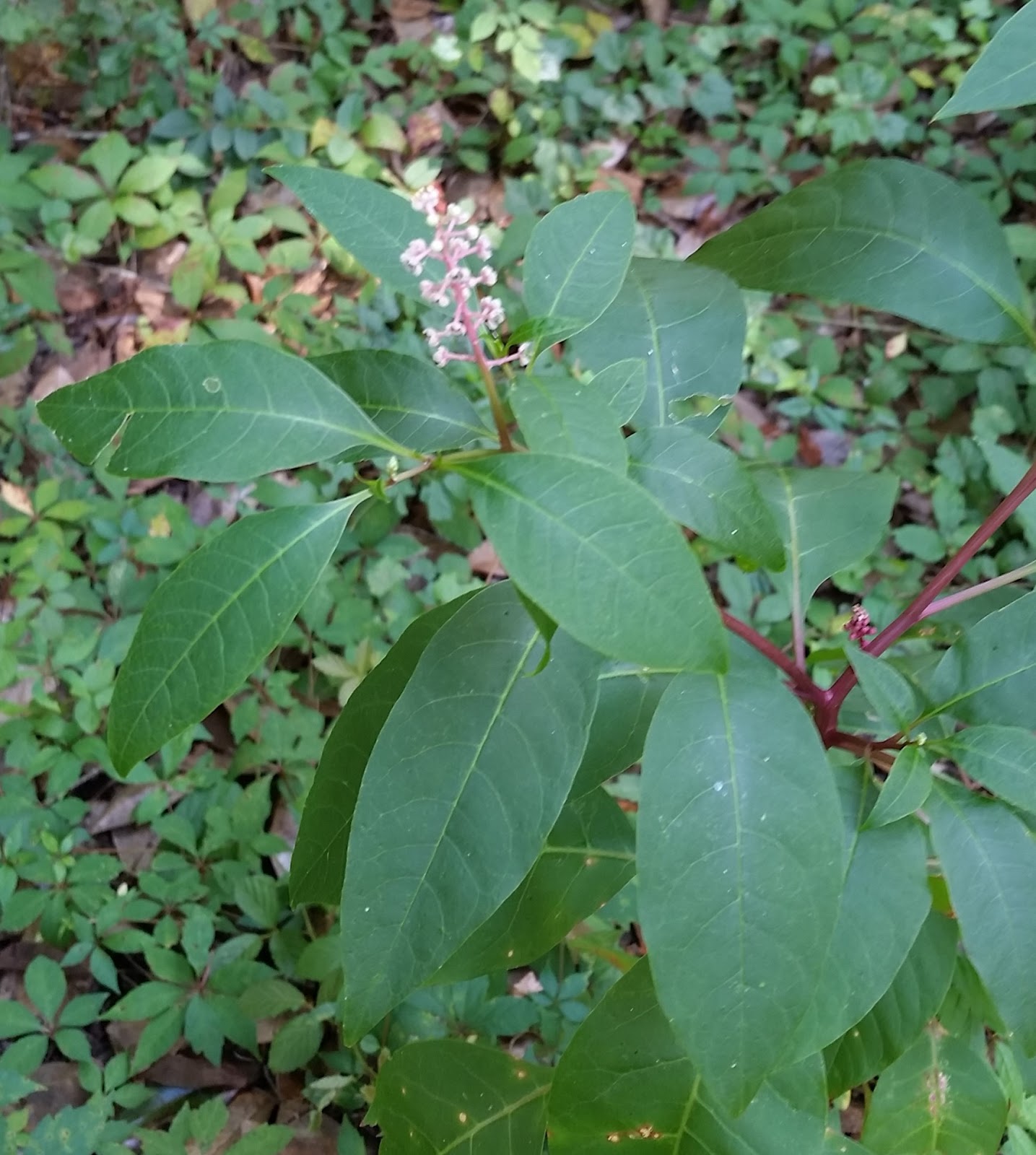
Pokeweed

Common Names: Pokeweed, American pokeweed, poke salad, poke sallet, pokeberry, inkberry, American nightshade, American spinach, scoke, pigeonberry, dragonberries, red weed, red ink
Latin Names: Phytolacca americana
Type: Herbaceous
Origin: Native

Edible: Poisonous when any part is eaten raw. Young shoots and leaves can be boiled and eaten. Some sources say it must be boiled 2-3 times with the water changed each time.

Other uses: Medicinal uses. Dye and ink from the berries. Birds eat the berries.

Note: In the back near the woods.

Pokeweed (June)

Pokeweed (June)

Unknown plant 6

Common Names: x
Latin Names: x
Type: Herbaceous
Origin: x

Edible: x

Other uses: x

Note: In the grass and out by the road.

x (April)

Unknown plant 5

Common Names: x
Latin Names: x
Type: Herbaceous
Origin: x

Edible: x

Other uses: x

Note: In the grass.

x (June)

x (June)
x (June)


Unknown Plant 4

Common Names: x
Latin Names: x
Type: Herbaceous
Origin: x

Edible: x

Other uses: x

Note: In the grass.

x (June)

x (June)
x (June)


Thursday, June 11, 2020

Stemless carline thistle

Common Names: Stemless carline thistle, dwarf carline thistle, silver thistle
Latin Names: Carlina acaulis
Type: Herbaceous
Origin: Native

Edible: Flowering head can be cooked as an artichoke substitute.

Other uses: Some medicinal uses of the root. It is said this can be used as a barometer since the head will close up when rain is coming or here. Apparently this works for both a live plant and a dried one!

Note: In the wet field in back but in the drier areas. Unsure of species (Carlina acanthifolia or Carlina acaulis or something else). Need to see flower.

Stemless carline thistle (June)

Stemless carline thistle (June)

Stemless carline thistle (June)


Bogbutton

Common Names:  Bogbutton, bog button, small’s bog buttons, whitehead bogbutton, hairy pipewort, hat-pins, bog bachelor’s buttons
Latin Names: Lachnocaulon anceps
Type: Herbaceous
Origin: Native

Description: Small diameter stems for the flowers grow up to 18” tall. Small leaves at the base of the plant. The flower is a dense cluster of small white to gray flowers that forms a ball.

Edible: No.

Other uses: None found.

Notes: In the wet field in back. Blooms June-September.


Bogbutton (June)


Bogbutton (June)

Bogbutton (June)

Bogbutton (June)

Bogbutton (June)


Orange Milkwort

Common Names: Orange milkwort, yellow milkwort, bog cheetos, candyweed, red-hot poker, bog bachelor button
Latin Names: Polygala lutea
Type: Herbaceous
Origin: Native

Description: The plant grows up to 12” tall. The leaves are around 1” long and thick. Flowers are orange and 0.5-1” long.

Edible: No info found. Perhaps a tea can be made from the leaves. A relative (polygala nana) has an edible root.

Other uses: Medicinal. Attracts butterflies.
Notes: In the wet field in back and typically found in wet sandy soil, bogs, and swamps. Blooms in June-July. Flowers turn yellow when dried. The Latin word luteus is a saffron-yellow or yellow/orange. Online says this is a biennial so that I shouldn’t see flowers the 2nd year. Found blooms the 2nd year but different plants in a slightly different location. However, it also says this is plant the likes fires it can only grow without competition. We’ve mowed this area and just now are letting it go natural so it may disappear over time.


Orange milkwort (June)

Orange milkwort (June)

Orange milkwort (June)

Orange milkwort (April)

Orange milkwort (April)


Feather-stem Clubmoss

Common Names: Feather-stem clubmoss, harper's club-moss
Latin Names: Lycopodiella prostrata
Type: Herbaceous
Origin: Native
Edible: No

Other uses: The spores of lycopods are flammable and were used in fireworks and other flame-effects.

Note: In the wet field in back. Saw the plants after a week of major rain and the field was wet. The plants have disappeared within a few weeks as things dried out. I'm just seeing decomposed plants when the field is dry.

The genus of Lycopodiella is called bog mosses. Not sure if this is prostrata or possibly appressa. Need to watch over time.

Clubmoss (June)

Clubmoss (June)


Sunday, June 7, 2020

Wild Lettuce

Common Names: Wild lettuce, bitter lettuce, opium lettuce, poisonous lettuce, tall lettuce, great lettuce
Latin Names: Lactuca virosa
Type: Herbaceous
Origin: Introduced from Europe but not considered invasive.

Edible: The leaves are bitter but edible. Younger leaves are better. Can be eaten raw or cooked as a potherb or boiled.

Other uses: Medicinal - The plant secrets a white milky substance from the veins. When it is dried it is used for sedative and pain-relief effects. Referred to as poor man's opium.

Wild lettuce (April)


Friday, May 22, 2020

Brazil Pusley

Common Names: Brazil pusley, tropical Mexican clover, Brazilian calla-lily, white-eye
Latin Names: Richardia brasiliensis 

Could be Richardia scabra which is native.

Type: Herbaceous
Origin: Native to Brazil. 

Description: Opposite leaves. Small starlike white flowers.

Richardia brasiliensis leaves are uniformly covered with hairs. Richardia scabra leaves are less hairy towards the middle. Need to confirm.

Edible: No. Not much info out there on this being edible with some varieties causing nausea, so I'm not trying it!
Other uses: Attracts butterflies and bees. Medicinal uses. Used as soil cover.
Notes: Found by the shop. There are some horror stories of this taking over lawns so I pulled up everything I could find though some came back.


 Brazil pusley (April)

 Brazil pusley  (April)

 Brazil pusley  (April)

Thursday, May 21, 2020

Lyre-leaf Sage

Common Names: Lyre-leaf sage, wild sage, cancerweed, cancer root
Latin Names: Salvia lyrata
Type: Herbaceous
Origin: Native

Edible: Leaves can be used in a salad or as a potherb. The young leaves are the most tender. Flowers are edible in a salad. Seeds can be ground and mixed with other grains to make flour. Entire plant can be dried to make a tea and often used to sooth a sore throat.

Other uses: Medicinal. Attracts butterflies and hummingbirds.

Note: Leaves or roots were thought to be an external cure for skin cancer in the past. Others say it it is called cancerweed because it "spreads like cancer". Mostly found in the lawn or around the pond.
Lyre-leaf sage (April)


Lyre-leaf sage (April)

Sunday, May 3, 2020

Cutleaf Evening Primrose

Common Names: Cutleaf evening primrose
Latin Names: Oenothera lacinata
Type: Herbaceous
Origin: Native

Edible: Young leaves and flowers are edible raw in a salad or cooked as a potherb. Root can be cooked but may take a few changes of water.
--> Leaves and flowers are pretty good raw in early May.

Other uses: Attracts bees. Some medicinal uses.

Cutleaf evening primrose (April)

Cutleaf evening primrose (April)

Cutleaf evening primrose (April)

Cutleaf evening primrose (April)